Hunt has done an enormous service to Kashmir by preserving the representations, which often swing like a pendulum between a heavenly abode and a place ravaged by strife.
By the time the seething summer of 2010 thawed, 118 people had lost their lives across the valley. Years later, the telling number would become an index for 118 conversations in Alana Hunt’s book — 118 cups of Nun Chai. One chai for one casualty.
Nun Chai is made with green tea leaves, a specific kind, available in Kashmir. The pink colour is credited to the reaction of baking soda with the green tea leaves. So. Pink personifies pain. It’s also a brewage of hope.
In June 2016, Cups of Nun Chai was serialized in Kashmir Reader. The state government banned the newspaper amid another seething summer in the valley, and the project remained incomplete.
It may not be easy to bring dead back in Kashmir in writings, but Cups of Nun Chai bears witness to the vale’s woe, a la Dickensian.
Hunt—who first visited Kashmir in 2009—is adept at harnessing all the conventions of the Dickensian novel—including startling coincidences and sudden swerves of misfortune—to lend Kashmir’s story a stark, bleak dimension, as well as a visceral appreciation of the randomness of life and fate’s sometimes wicked sense of humour.
“Each of us has his own rhythm of suffering,” said Roland Barthes. This book mainly deals with the suffering of Kashmir. And it does so honestly.
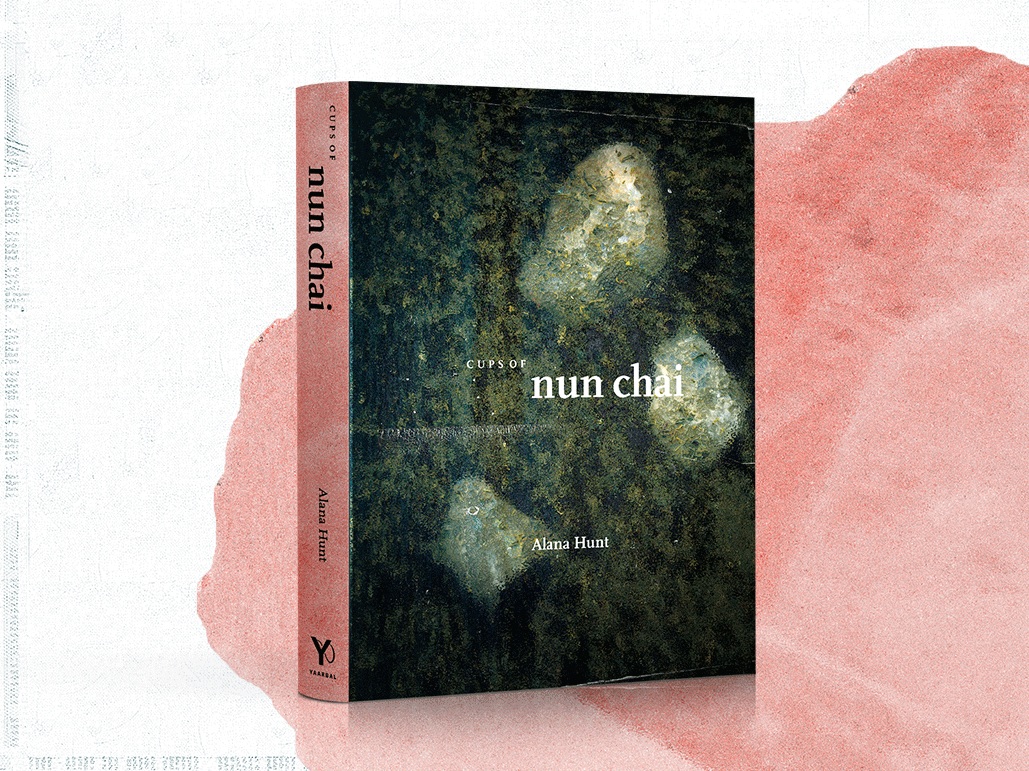
Cups Of Nun Chai is difficult work. It’s emotional for a Kashmir to revisit the days of wrath in her writings. But as she travels, she brings lots of places alive. And compares the global crises with Kashmir.
Hunt is also an artist and her book is art. It’s about death. But its appearance is like a school kid enjoying ice cream on a hot summer afternoon in present-day Syria.
The author’s engagement with the searing subject is global in appeal. She has shared cups of nun chai with people in Kashmir and across Australia, Bangkok, and Europe. The conversations were always about injustice happening in the different parts of the world.
Hunt’s book is a search for meaning in the face of something so vicious it appears absurd.
Reading the book makes you revisit some haunting bygone moments in Kashmir. When I was little, in Batamaloo, there used to be prolonged curfews. We could not buy milk for the tea for days. My grandmother would grind rice. Fry it. We would have that with tea. The remaining of the fried broken rice in the dark milk-less nun chai would look like bloody white teeth.
Hunt has done an enormous service to Kashmir by preserving these representations, which often swing like a pendulum between a heavenly abode and a place ravaged by strife. She tries to evade this binary and into the complex spaces in lateral and oblique ways.
As an artist, she wrestles with visual representation limits, which is how she came to employ language in this book.
The gesture of holding each cup of nun chai acts as an accumulating allegory of care in the face of what is otherwise an extreme situation.
The sharing of pain, Berger writes in The Shape of a Pocket, is one of the essential preconditions for refinding dignity and hope. Much pain is unshareable. But the will to share pain is shareable. And from that inevitably, inadequate sharing comes resistance.
With lucid language and exemplary storytelling, Hunt is overcoming a hitch—an apparent jinx in local legends—about Kashmir in world literature.
Leave a Reply